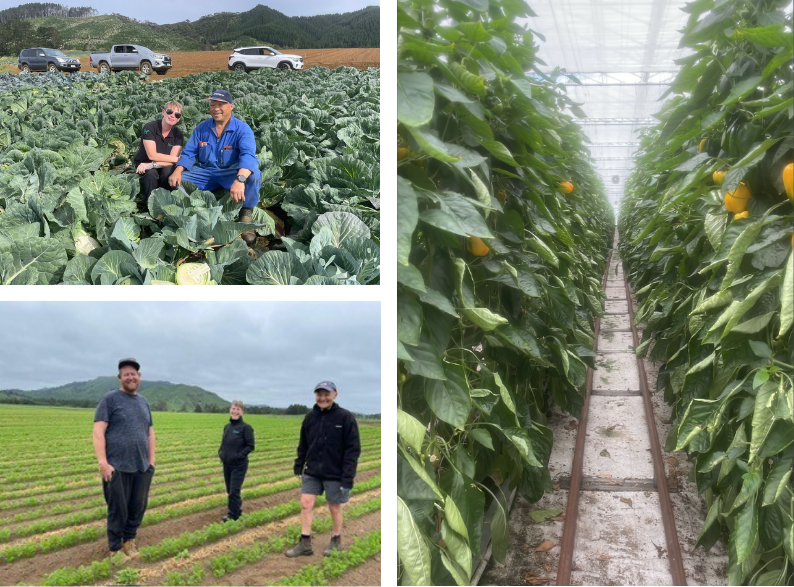
In December, I had the privilege of visiting New Zealand, funded by the LSA Fellowship Scheme, RHS Bursary, and Hazera UK. My two-week journey included one week with Terranova Seeds and another with Vigour Seeds, allowing me to explore the horticultural practices of over 20 different growers across both the North and South Islands. Here are some highlights from my trip, with a special focus on both onions and carrots, as these were the main crops I toured.
New Zealand’s horticulture industry is a vital part of its economy, contributing significantly to the country’s GDP. New Zealand, with a population of 5 million, grows enough vegetables to feed 59 million people, exporting a large portion of its produce, including capsicum, onions, and squash.
The sector has shown remarkable resilience and adaptability, especially in recent years. In 2023, New Zealand had approximately 4,951.8 hectares of onions planted, with about 85% of these onions being exported, making it the top fresh vegetable export. The main growing regions include Auckland, Waikato, Canterbury, Hawke’s Bay, and Manawatu-Wanganui. In 2021, New Zealand exported over 200,000 tonnes of onions. Carrot production is also significant, with nearly 2,000 hectares grown in 2018, and Canterbury being the main growing region.
During my first week, I was hosted by Kathryn Wells, John Phillips, and Ingrid Ennis at Terranova Seeds. Terranova Seeds, with 14 workers and a 5-member sales team, has been in operation for 21 years. John Phillips, the general manager, has been with the company since its inception. Terranova Seeds, originally part of Yates, was sold off and now operates in both New Zealand and Australia. The company is based in Auckland and also employs David Stewart who covers the South Island.
On Monday, I visited Gourmet Paprika, where Casey Smilie gave us a tour. They grow peppers, shipping about 40 tonnes mainly by air freight to Japan, New Zealand, and Australia. The greenhouses, mostly heated by gas in the North Island and coal in the South, survived two tropical cyclones last summer. They use geothermal greenhouses and advanced techniques like infrared cameras to manage temperatures and reduce pesticide use by employing natural predators like mites and lacewings.
On Tuesday, I visited Nga Rakau, a plant raiser, where I learned about their use of Canadian peat and vermiculite for germination. They focus on conservation, raising native trees and bushes, and producing Manuka honey trees. Later, I visited AS Wilcox in Pukekohe, where I met Russell Watt. They mainly supply onions and carrots domestically and export 65% of their harvest to Asia and Europe. They grow onions in four regions to ensure year-round supply. Pukekohe, with its clay soil, is ideal for onions but challenging for carrots. They use advanced harvesting techniques and focus on reliable, high-yield carrot varieties.
On Wednesday, I visited Kim Young and Sons in Ohakune, who process 120 tonnes of carrots and 40 tonnes of potatoes daily. They use optical graders and have a strong focus on reducing waste by selling “wonky” vegetables. Their innovative approach has significantly increased the value of second-grade produce.
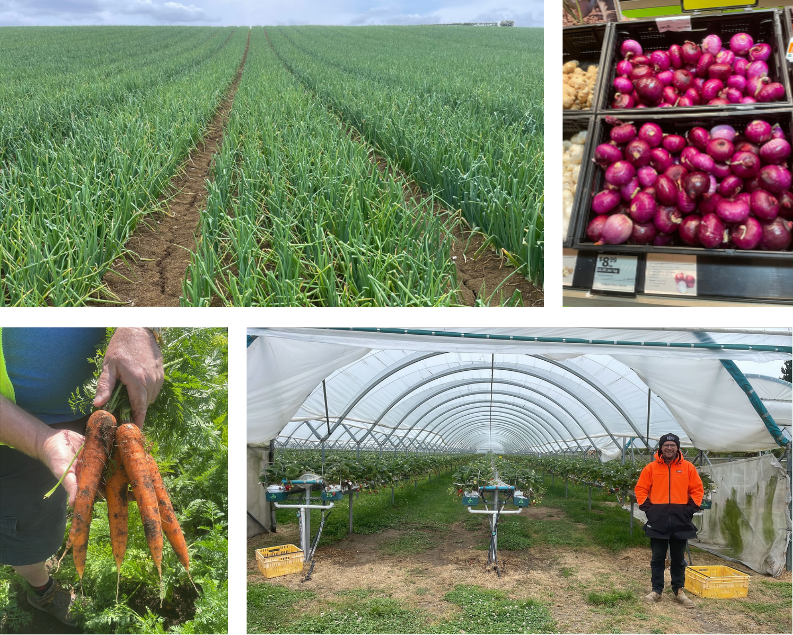
Steve McArthur, agronomist and owner of Vigour Seeds, was an incredible host during my second week in New Zealand. He took me to visit several large onion and carrot growers, providing deep insights into their operations and the challenges they face.
At Lovett Family Farms, Steve and Daniel Lovett conduct bi-weekly field inspections to assess the needs for herbicides, pesticides, and fertilizers. Daniel taught me about the entry points for thrips in onion crops and the extensive selection of chemicals available in New Zealand compared to the UK. Their proactive approach to pest management ensures high-quality onion production.
Another large grower, Greg Tucker of G&S Tucker, shared his experiences with pest management and the importance of regular field inspections to maintain crop health. His insights into the local growing conditions and challenges were invaluable.
Steve continued to guide me through various farms in Nelson, where I met Karen Silva at Appleby Fresh. As the agronomist and cropping manager, Karen manages 35 different crops over 180 hectares. She discussed the challenges of managing club root and weeds in stony soil, and the importance of efficient irrigation in a resource-limited environment. Her innovative solutions to these challenges were impressive.
In Hawkes Bay, Steve and I visited several key growers, including Dereck Ferguson and Lance Pratt at Brownrigg Agriculture. Steve recommended strategies for managing their onion and carrot crops to maximize yield and quality. He emphasized the importance of balancing vegetative growth with yield optimization, especially for vigorous late-maturing varieties like Cartier and Haeckero. Their commitment to quality and efficiency was evident in their operations.
Steve also took me to visit Neil Redelinghuys at Leaderbrand in Ashburton. Neil manages broccoli production year-round and shared insights into their seed production for spring onions and the challenges of managing large-scale broccoli harvesting. Their focus on sustainability and innovation was inspiring.
Finally, I visited Jason Easton at Easton Agriculture. Jason’s operation grows approximately 4,000 tonnes of onions for export. He collaborates with Fruitfed Supplies on R&D trials to find effective and competitively priced alternatives to restricted chemicals. His dedication to continuous improvement and research was impressive.
My visits with Steve McArthur were incredibly informative. His expertise and dedication to improving onion production in New Zealand were evident in every farm we visited. The growers’ innovative practices and commitment to sustainability left a lasting impression on me. This trip not only expanded my knowledge of horticultural practices but also highlighted the importance of collaboration and continuous improvement in the industry. New Zealand’s ability to produce high-quality onions and carrots year-round, despite various challenges, is a testament to their expertise and resilience.
This journey provided a comprehensive understanding of New Zealand’s horticultural landscape, especially in onion and carrot production. The dedication and innovation of the growers I met were truly inspiring. New Zealand’s horticulture industry continues to thrive, driven by a commitment to quality, sustainability, and continuous improvement. This experience has enriched my perspective and will undoubtedly influence my future work in horticulture.
Kym Smith, 2023 Fellow
 LSA CT Fellowship Scheme