On the 19th of August, I had the opportunity to take part in a deeply insightful truffle study tour, which offered a comprehensive and hands-on perspective into the cultivation, management, and commercialisation of truffles — from detailed crop husbandry to the evolving role of agrotourism. The day provided a rich understanding of the complexity and nuance involved in growing this highly prized crop.
We began by meeting the head of the regional Truffle Growers group of the Vaud region, along with two of his colleagues, who provided a detailed overview of the local truffle sector. One of the most striking takeaways was his clarification of several commonly held misconceptions and assumptions about truffle cultivation — from pest and disease considerations to realistic timelines for crop production.
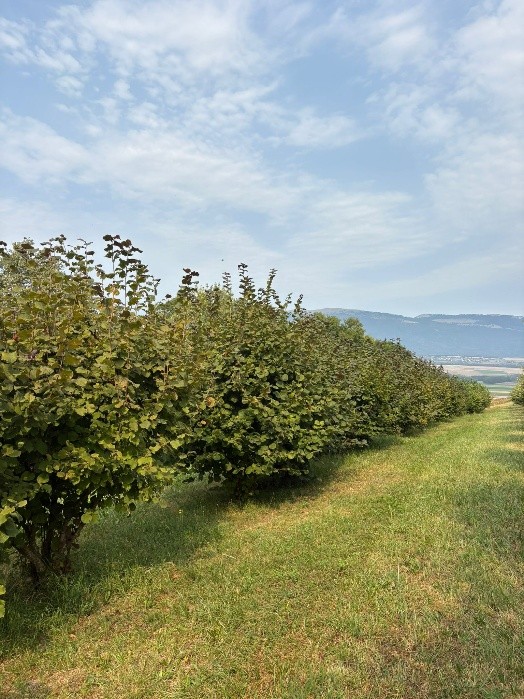
Our visits to five different plantations, each at a different stage of maturity, offered valuable insight into the range of methods used by growers. While many orchards were planted with oak and chestnut — the traditional host species — we also encountered experimental plantings involving elm and hazel, reflecting a growing interest in diversification. Some sites featured newly planted trees inoculated with truffle spores (either in the nursery or through natural soil exposure), while others were already showing signs of truffle formation, with distinct ‘brûlé’ zones — the bare patches where truffle mycelium suppresses surrounding vegetation.
One surprising discovery was the generous tree spacing, typically between 6 and 9 metres, which was far wider than I had anticipated. In some cases, trees were planted in pairs to reduce light penetration, a technique believed to encourage truffle development — particularly in Burgundy truffle orchards. Black truffles, by contrast, are generally cultivated with single trees in warm, calcareous soils.
In the afternoon, we visited a well-established, agrotourism-focused plantation, carefully designed to engage visitors. With mapped walking routes, interpretive signage, and truffle-hunting demonstrations using trained dogs, the site showcased how tourism can serve as a vital supplementary income while orchards mature. Activities such as tastings, seasonal workshops, and guided tours have proven highly effective in generating revenue and raising public awareness. It was inspiring to see how the business was exploring multiple avenues to achieve sustainability.
To conclude the day, we visited a plantation employing a fully irrigated system, which provided an interesting contrast to the previous non irrigated sites. The grower explained how small, controlled amounts of water (around 20 mm) are applied annually to orchards. The results were clear: well-developed brûlés and visibly healthy trees and more predictable harvest cycles.
Overall, the experience was an exciting opportunity to explore a world completely different from my usual work—blending scientific rigour with practical expertise in a way that was both eye-opening and inspiring. It also gave me the chance to practice networking in new spaces, connecting with members of the horticulture community I wouldn’t have been able to engage with otherwise. While truffle cultivation is slow and labour-intensive, the insights gained offered fresh perspectives on innovation and sustainable practices that could inform a wide range of fields beyond horticulture.
Alice Bourne, 2024 Fellow
 LSA CT Fellowship Scheme